“A book’s title is part of the story in itself. It provides an angle, and it adds to its content… It’s the very beginning of it.”
When I first started working on this book, Rhythm Reset was not the name I had in mind. In fact, the title I was seriously considering was Burnout to Balance.
Before arriving at that name, I spent considerable time thinking through the foundation of the book — sketching the content, defining the reader profile, clarifying the intention behind it, and reflecting on how it might truly help someone who reads it. It was not just about choosing an attractive title; it was about finding words that could capture the journey the book was trying to describe.
After many rounds of contemplation, the phrase Burnout to Balance began to feel meaningful. It captured the transition I wanted to explore — the movement from constant exhaustion toward a more sustainable rhythm of living and working. At that stage, I was quite convinced that this would be the name of the book. I even created a dummy cover page with that title and my name on it, just to make the dream feel more real. That early cover design, however, belongs to another part of the story, which I will share in the next blog.
After my earlier attempts at writing books had stalled at different stages, I wanted to approach this one differently. This time, I gave myself a clearer structure before beginning. I created a framework with ten chapters so that the ideas had both direction and boundaries.
With the structure ready, I began writing.
Sometimes I worked deeply on a single chapter, writing, rewriting, and refining until I felt comfortable with the content. At other times, I drafted a chapter and moved forward so the flow of ideas would not be lost, planning to return later for editing.
Many writing guides suggest avoiding editing while writing because it interrupts the flow. But I quickly realised that this advice did not work for me. I often needed to pause, reread what I had written, adjust it, and then continue. Eventually, I told myself, It’s okay, Anitha. You don’t have to follow every rule that other authors suggest. Each writer finds their own rhythm.
Balancing writing with a full-time job added another layer to the process. The December vacation became an important window where I could dedicate longer stretches of time. After that, my plan was to write mostly on weekends and perhaps an hour or two after dinner on weekdays.
But writing rarely followed the schedule I had imagined.
Many evenings when I sat down to write after dinner, I found it difficult to stop. What looked simple on paper often took far longer to shape into something meaningful. With my background as a technical writer, I have always believed in clarity and simplicity. If something can be said in 100 words, I never feel comfortable using 300. I wanted the book to be written in simple language that anyone could connect with.
That commitment to clarity meant revisiting sentences repeatedly, shaping them until they felt right. Late nights slowly became more frequent. Ironically, while writing about burnout, I sometimes began to feel a little of it myself.
Somewhere during this process, another realisation began to surface. While Burnout to Balance worked well as a theme and even as a keyword, I did not want the word Burnout staring back from the cover of my book. It felt heavy and tiring as a title.
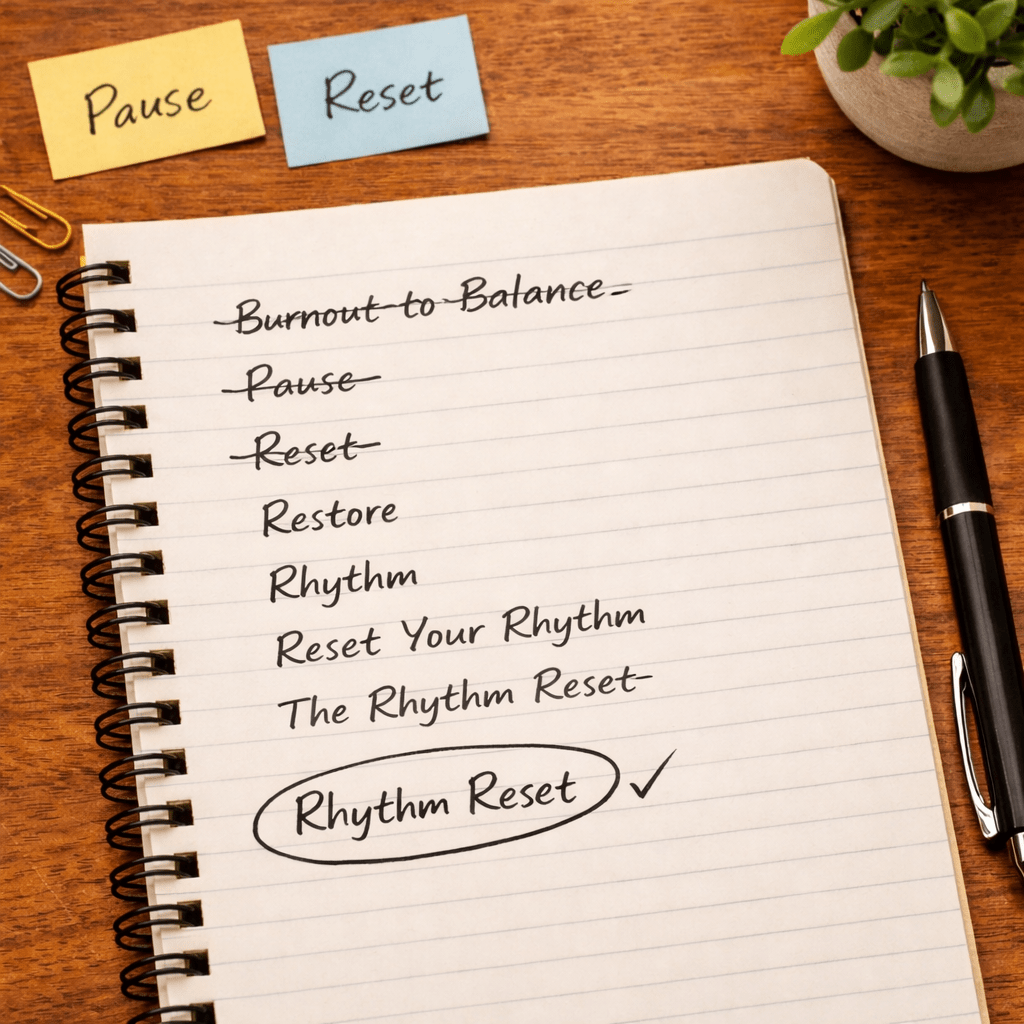
So I decided to move it to the subtitle instead and started searching for a new title. Whenever I paused writing, my mind began playing with words — Pause, Reset, Restore, Renew. Many combinations appeared and disappeared.
Then one day, the word Rhythm surfaced.
The moment it appeared, something clicked. I loved the sound of it. It also felt beautifully connected to my website, Resonance of Life. Rhythm suggested balance, flow, and sustainability, exactly what the book was trying to explore.
I experimented with a few variations:
Reset your Rhythm
Reset Rhythm
The Rhythm Reset
But eventually, the simplest version felt right.
Rhythm Reset.
Once the title was finalised, the next challenge was the subtitle. Interestingly, until I began writing my own book, I had never paid much attention to subtitles. But once I started observing them closely, their length, structure, and the role of keywords, I was amazed by how much thought goes into them.
After considerable research, experimentation, and many permutations, the subtitle took shape:
Burnout to Balance for Working Women Who Carry It All
Interestingly, it took a conversation with a friend for me to realise that the phrase could be misunderstood. She asked, “Why did you write a book only for working women and not for all women?”
I was surprised. Women work everywhere and often all the time — at home, in communities, in schools, in offices, and in countless roles that are rarely acknowledged as work.
Later, after reading parts of the book, she shared something that stayed with me. She said she wished she had read it 10 years ago. It would have helped her better. That moment reassured me. The book had not excluded anyone. Instead, it had simply opened a conversation many women quietly live through. Whether they work at home or outside, each of them carries an invisible load.
Looking back now, the journey to naming the book feels very much like the journey of writing it, a process of exploration, hesitation, adjustment, and eventually finding the rhythm that felt right.
And perhaps that is what this book is really about: helping us notice how we live and gently reshaping them so life becomes more sustainable for those who carry so much.
In the next blog, I will share another part of the journey — how the cover design came to life and what inspired its visual story.
Anitha KC
 Resonance of Life
The blog covers the main idea behind writing the book.Excellent presentation
LikeLike
I can’t agree more on all the thought process that you’ve been through. Indeed it is worth it. The title looks and sounds simple but profound.
i am sure many will appreciate.
LikeLike