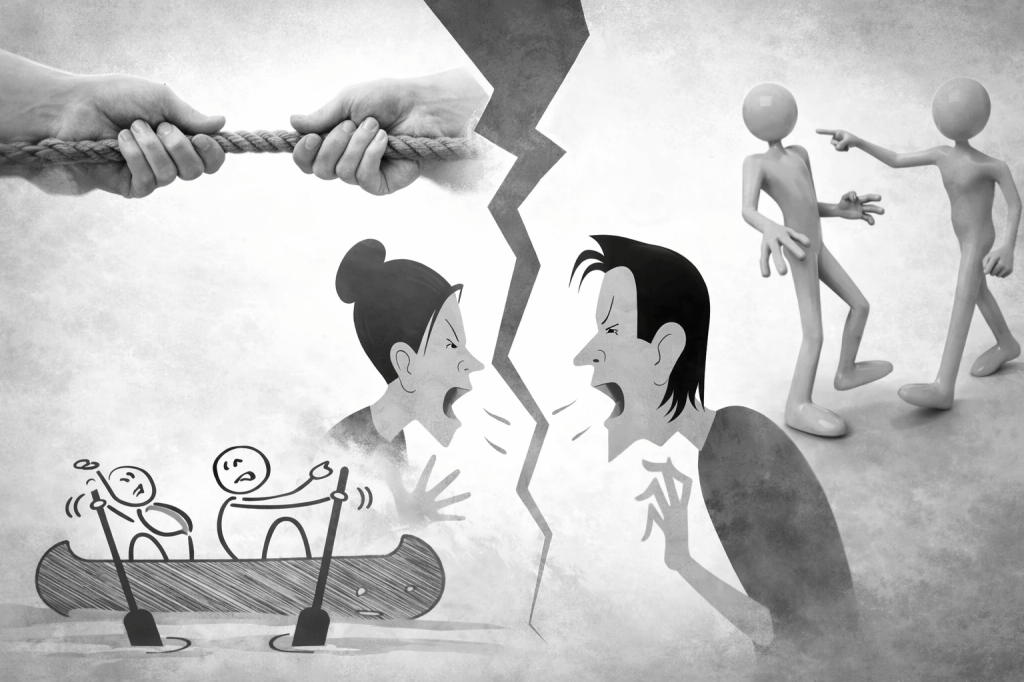
Why do we get into conflicts? We come across different types of problems with different people. Almost every day, we encounter situations that make us feel angry, upset, or uncomfortable around those we interact with. It could happen with friends, neighbours, parents, spouses, children, colleagues, managers, subordinates, helpers, or even fellow drivers on the road.
Conflicts seem to be a part of everyday life. But what is the real reason behind them? Is it because we are right? Or because the other person is wrong? Do we search for mistakes in others just to satisfy our ego? Are these really big problems?
Most of the time, very trivial matters grow into major issues, depending on our mood and the kind of day we are having. But why does this happen?
When you feel strongly that you are right, and the other person feels just as strongly that they are right, where does the problem begin? Of course, there can be real conflicts in some situations. However, in most cases, they can be resolved with a little patience and thoughtful reflection. To understand this better, let us look at the root of the problem, the way.
There is no single way of doing any work. What feels like the right way for me may not feel right for you. Naturally, this makes it easy for us to argue about who is correct. For almost everything, we tend to assume our way of doing things is the best way.
When another person defends their approach as the way, conflict begins. We forget that there can be many ways to reach the same outcome. The preferred path often depends on personal preferences, circumstances, and priorities.

Let us take a simple example. Suppose we need to go from the start to the endpoint. Depending on the weather, distance, preferred mode of transport, type of vehicle, or even the work one can complete along the way, each person may choose a different route.
There is nothing wrong with this. As long as everyone reaches the destination on time, why should it matter? Only in a road race does everyone need to follow the same path. Otherwise, different routes are fine.
I may choose Start–4–5–End, while you may prefer Start-6–10–5 -End because you enjoy driving in that area. If we allow each other to choose freely, there will be no problem. But once I decide that my route is The Way, I may start insisting that others follow it too. And if you choose differently, I may become irritated or angry.
How does this show up in daily life? This pattern does not appear only in travel. It can be seen in the way we eat, cook, dress, behave, work, exercise, talk, smile, or live our daily lives.
When we believe that only one specific way is the right way, we slowly become intolerant of others. It becomes difficult to accept people when they do things differently from us. Without realising it, we start judging, correcting, and resisting — and conflicts arise.
Awareness is the key. When we notice our fixed ideas and rigid expectations, we can begin to loosen them. We can remind ourselves that our way is only one way — not the way. By doing this, we become more open to others and more accepting of how they work and live.
Instead of focusing on minor differences, we can focus on the destination — the real purpose behind what we are trying to achieve. This shift helps us avoid unnecessary arguments and emotional stress.
Can you think of some ways in which you may be holding on too tightly to “your way”? Where could you allow more flexibility? And how do you plan to begin letting go?
—Anitha KC
 Resonance of Life
Leave a comment