
As the year unfolds, my reading list keeps growing. I have completed one book and started two others from the list—and now the third book has arrived in my hands.
A casual evening chat with a friend turned into a deep philosophical discussion that lasted for hours. That’s the beauty of face-to-face conversations! You can sense the surroundings, read expressions, and let thoughts flow like a river, drenching your mind with happiness. A good conversation can be as satisfying as reading a great book. That evening gave me both—because she handed me a book to read. I was delighted to see the author’s name: Louise Hay. I listened to her audio recordings and read a few pieces online, but this is the first book of hers I’m holding in my hands.
I started reading the book that very day. I’m already halfway through and have ordered a copy for myself. I am impressed by the author’s thoughts on various aspects of life. This reminds me of my office friends—whenever I talk about the books I read, they ask me to summarize them. It’s easier for them to learn without reading! So, I thought of penning down a few ideas to help others who may not pick up this book. I’ll start with one topic and may write more articles under this theme.
What are your Beliefs?
Have you ever taken stock of your beliefs? I hadn’t done it before. Most of us know the benefits of de-cluttering and tidying up.
How do you declutter your wardrobe? You take all the clothes out and see what you have. Check which ones fit well and reflect your current interests and style. Decide whether to donate or dispose of clothes you no longer feel like wearing—or recycle them for another purpose. As you pull out the clothes, you realize what you own! I believe Pareto’s 80/20 rule applies to wardrobes too—we use only 20% of our clothes 80% of the time. We stare at the remaining 80% and still think we have nothing to wear. Why? Because we don’t like those clothes anymore. Yet we keep them because we spent money on them, received them as gifts, or have emotional attachments. Some may be brand new and unworn, others worn-out but kept for sentimental reasons, and a few remind us of special occasions, places, or people.
So, we have different categories of clothes with different needs, such as:
- Ones that are old but still usable now and in the future
- Ones that require a wash
- Ones that need professional care
- Ones that need fixing
- Ones that are great for frequent use, but were hidden behind others
- Ones we have outgrown in size or style, not usable anymore
- Ones to be thrown away
- Ones that are missing and need to be bought
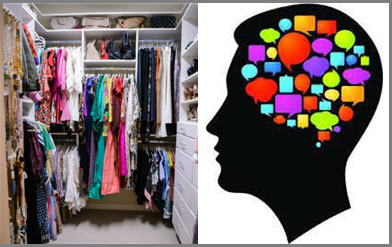
Are you wondering why I am writing about the clothes? Why am I reminding you of the pending clean-ups? Hold on, as we are gearing up for a task important than that. Tougher than sorting the clothes in the closet: sorting out your beliefs!
How many beliefs do you have? When did you start building a closet for them? From the time you came into this world as a baby? Where did you pick those beliefs—from parents, family, neighbors, friends, teachers? From books, newspapers, TV shows, news, movies, advertisements, social media, forwarded messages, schools, colleges, workplaces, and countless other sources? Which beliefs did you consciously choose to keep, and which ones crept in without your permission? There may be a huge sack of beliefs you didn’t even know existed in your mind! Gradually, they seeped into your system through constant exposure. Shall we take stock of them and sort them out?
Are you serious about this? I am. Yes, it’s overwhelming, time-consuming, and exhausting—but let’s face it. Instead of procrastinating like we do with closet clean-ups, let’s take it up now. If you can’t do it immediately, at least commit to a date or weekend to start. This is an exercise for yourself—to keep your inner system in good condition. Exploring the outer world is easy: you can visit any place, take pretty pictures, and post them on social media. Such expeditions require time, money, and infrastructure.
Exploring inside requires none of that—no money, no transport, no external dependencies. It takes less time than traveling, but it demands loads of courage and willpower to dig deeper and look within. You may need to confront wrong beliefs or acknowledge ones you didn’t know you had. Let’s see some examples:
“You are good,” “You are lazy,” “You don’t look good,” “Your handwriting is good,” “You’re a fast learner,” “You don’t understand things,” “You’re an excellent communicator,” “You can’t handle situations properly,” “You mess up paperwork,” “Saving money is for people who earn less,” “People who don’t party are misers,” “People who go to malls are spendthrifts,” “You won’t look good in modern clothes,” “Vegetarians are weak,” “Exercise is a waste of time,” “Self-help books are for losers,” “Politics is bad,” “Investing is risky,” “My country is the best place to live,” “My country is the worst place to live,” and so on. Each of us is hoarding loads of beliefs!
Take the example of not trusting strangers. Parents teach toddlers this for safety—and it’s right for that age. But as adults, holding on to that belief makes no sense. You need a strategy and logic to decide whom to trust. Like this, you need to audit your beliefs: Which are good for you? Which are outdated? Which need mending, discarding, polishing, or replacing?
Just like your closet, here’s the belief checklist:
- Ones that are missing—you need to bring them in
- Ones that are old but still useful now and in the future
- Ones that need a wash (refreshing)
- Ones that need professional care (deep work)
- Ones that need fixing
- Ones that are great for frequent use but hidden behind others
- Ones you’ve outgrown—not usable anymore
- Ones to be thrown away
- Ones that are missing and you need to buy/bring them in
Do you see how this applies to beliefs, too? Let’s plan some steps to clean up your belief system.
What to do with your beliefs?
- Commit yourself to change—set a time for this exercise.
- Keep away from distractions for at least 1–2 hours.
- Take a notebook and pen—or use a text editor if you prefer gadgets.
- List your beliefs in different areas: people, family, work, body, mind, parenting, finances, or any field you want to improve.
- Categorize them: fix, change, discard, honor, nourish.
- Decide to act on them based on your categorization.
- Look for beliefs that can help you grow—and consciously install them.
Remember, this may take time and feel exhausting—but trust the process. You’re on the right path to self-discovery and growth. Best wishes to you!
Feel free to share your experiences and suggestions in the comments. Let’s help each other!
— Anitha KC
Images: agsandrew / iStock / Getty Images/ google images
 Resonance of Life
Thanks Anitha, well written summary!!
LikeLiked by 1 person
Thank you, it is difficult to summarize this wonderful book. I am picking up the topics and concepts which are easier to relate to and implement. Hopefully, I would write on some more topics from this book in the coming days.
LikeLike
Well written
LikeLiked by 1 person
Great idea explained in a simple way. well done,keep contributing.
LikeLiked by 2 people
Thank you..Happy to follow your blog
LikeLiked by 1 person
Thank you, Athira
LikeLiked by 1 person
You’re always welcomr Anitha
LikeLiked by 1 person
Thank you for the encouraging words. Good to know that you liked the article.
LikeLike